Work Playground About

Interaction designer who

I design for industries where a well-designed experience isn't just pleasant. It's a matter of dignity, safety, and trust.

I think in systems, not just how they work, but who they work for and who they leave behind.

I look at a disruption recovery process and see not just a notification screen, but an entire system of human stress, operational chaos, and algorithmic decision-making.

Currently pursuing my M.Des at ArtCenter College of Design, building domain expertise in the industries where design decisions carry real weight.

Selected
Work

04 Projects
EM—01
01

Airline Interaction Design 2036

Designing the interaction layer for a future where AI-driven anticipation has replaced most active passenger decision-making. How do you design for agency when automation handles the logistics?

View case study →

Domain

Aviation

Type

Futures / Service Design

Duration

14 weeks

EM—02
02

Solace Health

A multi-city expansion framework that makes misalignment visible before it compounds into delays. Designing the organization, not just the interface.

View case study →

Domain

Healthcare

Type

Systems / Process

Duration

Team of 3

Follicular phase
COROS Today Dashboard
Luteal phase
03

COROS

COROS had no menstrual cycle tracking when I started this project. They launched one mid-way through, but it was just a calendar. I audited the full service and redesigned it into a system that connects cycle data to training.

View case study →

Domain

Wellness

Type

Service Design

EM—04
04

Airbnb Group Booking

Redesigning how Airbnb handles the hardest part of group trips — the money. Shared planning, flexible cost-splitting, and a group hub that gives every traveler agency.

View case study →

Domain

Travel

Type

Concept Redesign

Team

Pair

EM—05
05

WorkTrip

I saw a broken process at my own company — paper forms, lost requests, frustrated employees — and designed the fix. A self-initiated internal tool for corporate travel.

View case study →

Domain

Enterprise

Type

Self-Initiated

Company

Barge Design

EM—06
06

Patreon Discovery

Patreon knows who you support. It should also know who you'd love to discover. A redesigned discovery experience with Sage, an AI-powered creator guide.

View case study →

Domain

Creator Economy

Type

Concept Redesign

Design the systems people depend on with the craft those people deserve.

My path into design isn't traditional — and that's the point.

I studied international business and cultures, with a minor in religious studies and Spanish. I've always been drawn to the complexity of how people see the world differently, and how systems either support or fail them depending on who they are and where they're coming from.

Today I'm an interaction designer pursuing my M.Des at ArtCenter College of Design. The kind of designer who looks at a disruption recovery process and sees not just a notification screen, but an entire system of human stress, operational chaos, and algorithmic decision-making.

Emma Moystner

Let's
work
together.

I'm drawn to roles where design can make a positive impact. If that's your team, I'd love to connect.

Toolkit
Tools
Figma Adobe Creative Suite Unity Blender Claude Code Notion Miro HTML / CSS / JS
Methods
Systems Thinking Service Design Futures Research Cross-Functional Facilitation Sci-Fi Prototyping
Preview
One-Button Sound Unity
0 — 0
Tennis Canvas Game
Preview
Newton's Pendulum Blender
Preview
Project Title Prototype
Preview
Project Title Code
Preview
Project Title Interaction
Preview
Project Title Experiment
Preview
Project Title 3D
Preview
Project Title Side Quest
0 — 0
01 — Case Study

Airline Interaction Design 2036

When the airline knows what you need before you do, who is really in control? Designing the interaction layer for a future where AI-driven anticipation has replaced most active passenger decision-making.

RoleSole Designer & Researcher
DomainAviation
Duration14 weeks
MethodsFutures, Service Design, Sci-Fi Prototyping

Airlines are investing heavily in anticipatory technology — AI rebooking engines, biometric identity, ambient spatial interfaces — but they're designing for efficiency, not trust. Delta's AI concierge can already rebook you during disruptions. Biometric gates are rolling out globally. Parallel Reality displays at Detroit show personalized information to 100 passengers on a single screen.

The technology is arriving fast. The interaction design isn't keeping up. The gap isn't capability — it's legibility. When the system acts on your behalf without asking, passengers don't feel served. They feel surveilled.

I conducted a STEEPX analysis mapping emerging signals across social, technological, economic, environmental, political, and experiential dimensions. A Causal Layered Analysis dug beneath the surface-level technology trends to identify deeper structural beliefs.

Every signal converged on the same finding: the barrier to anticipatory systems isn't technology. It's trust.

Socially, post-pandemic travel anxiety is baseline. Technologically, the capability exists but adoption moves at the speed of trust, not innovation. Economically, dynamic pricing makes passengers feel surveilled, not served. Politically, biometric consent is now legally mandated interaction design. Experientially, passengers benchmark against Amazon and Apple Pay, not other airlines — that gap is structural.

The CLA and service blueprint surfaced three design mechanisms that became the project's backbone:

Adjustable autonomy. The system proposes, the passenger decides, and it remembers your preference. Not a binary on/off for AI — a spectrum of control the passenger can move along.

Explainability. Every AI decision shows its reasoning in plain language. When a flight cancels, the system offers three reroute options with tradeoffs: fastest arrival, best seat, most flexibility. It shows its work.

Resourcefulness. The system doesn't just recover from disruption — it finds new possibilities within it. Trust is earned not just by explaining and offering choices, but by being genuinely resourceful when things break.

The airline isn't trying to be invisible. It's trying to be a good host.

This thesis directly challenges the prevailing UX orthodoxy that the best technology is invisible. A good host is present but not intrusive, explains without lecturing, anticipates without presuming.

The project culminated in a narrated speculative film following Noah Almeida, an urban resilience planner flying Portland → Chicago → D.C. for a federal grant review. A storm cancels his Chicago connection. Under today's system, that's a rebooking desk, hold music, and a missed meeting. Under the 2036 system, the airline preemptively reroutes him through JFK, books an air taxi to D.C., adjusts his hotel, and sets his alarm — all while explaining what it's doing and giving him the choice to override.

Each scene was designed to test a different design mechanism: adjustable autonomy during the reroute, explainability when options are presented, resourcefulness when the system finds the air taxi alternative.

Supporting deliverables included the STEEPX analysis, Causal Layered Analysis, a future persona, a service blueprint, an Actor-Network Theory map, and five speculative design briefs.

The hardest design decision was resisting the urge to make the system invisible. The instinct in anticipatory design is to remove friction entirely — to make things "just work." But the CLA's deepest layer revealed that human agency is non-negotiable. A system that acts perfectly but invisibly isn't a good host. It's a benevolent captor.

The project's core argument: technology that anticipates your needs isn't enough. It has to show its work, give you choices, and be genuinely resourceful when things break. That's not invisible technology. That's a good host.
02 — Case Study

Solace Health

Designing the collaboration system, not just the interface. A multi-city expansion framework that makes misalignment visible before it compounds into delays, rework, and launches that miss the market.

RoleFramework Design Lead
DomainHealthcare
Team4 Designers
MethodsSystems Design, Process Design

Solace Health is a women's healthcare startup expanding from Austin across five cities. Growth exposed a structural problem: every city has different regulations, demographics, and clinical needs, and Austin's core team was making product decisions in isolation.

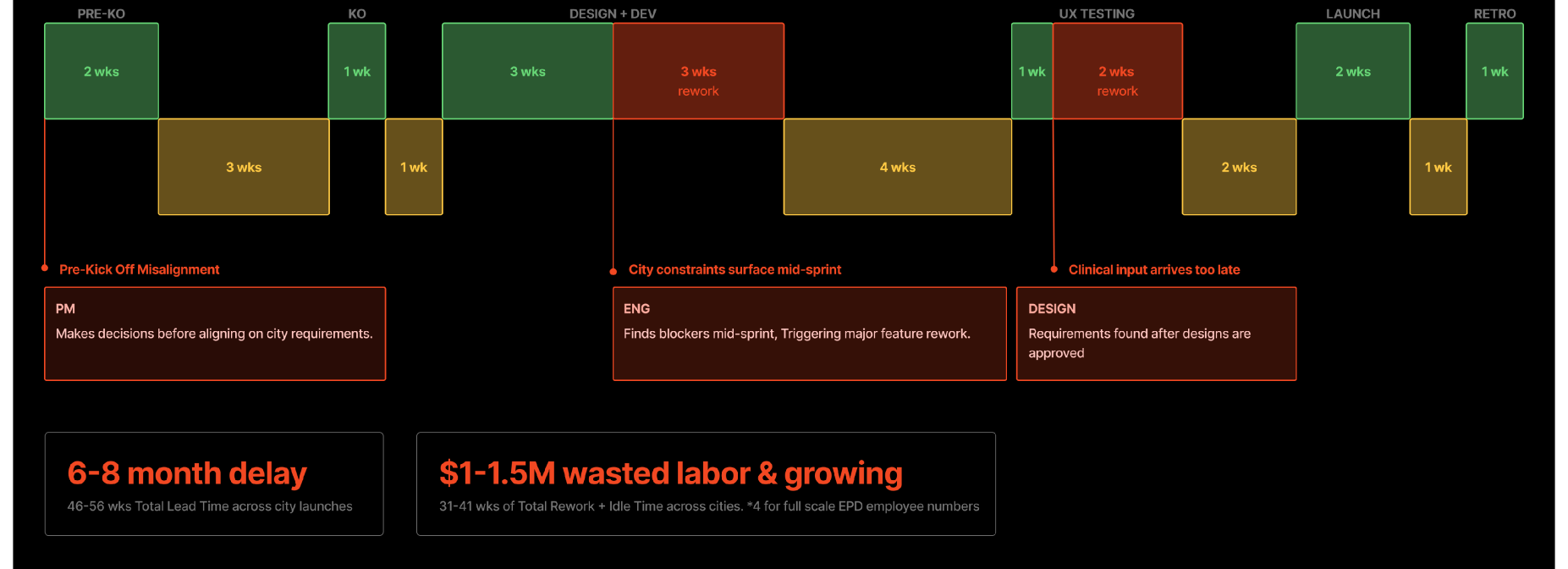
Six months before a new-city launch, three critical breakdowns were already in motion. The PM drafts roadmaps without cross-city input. Engineering hits architectural conflicts mid-sprint. Design discovers city-specific requirements after designs are already approved. The result: 6-8 month launch delays and $1.5M+ in wasted labor on rework alone.

Problem timeline showing delays and rework costs
Breakdowns compound across the launch cycle

We surveyed and interviewed 13 engineers, product managers, and designers across companies including Meta, Netflix, TikTok, Indeed, Walmart, and SAP. The synthesis surfaced a core tension: everyone is drowning in communication but starving for context.

When feasibility, direction, and customer value are answered early, all three disciplines are energized. But clarity is never spoon-fed — alignment has to be forged collectively.

Decisions happen without the people closest to the problem. The tools aren't broken — the gaps between them are. No tool bridged the space between disciplines, forcing teams to rely on meetings and tribal knowledge to stay aligned.

The solution isn't a single artifact — it's a system. Three interconnected layers, each reinforcing the others.

1. The Ritual — Pre-Kickoff Alignment Call. A structured 60-minute call before every city launch. The local PM presents first — local context, clinical constraints, demographic insights. Austin listens before it leads. A weekly async City Pulse Check keeps alignment alive between calls.

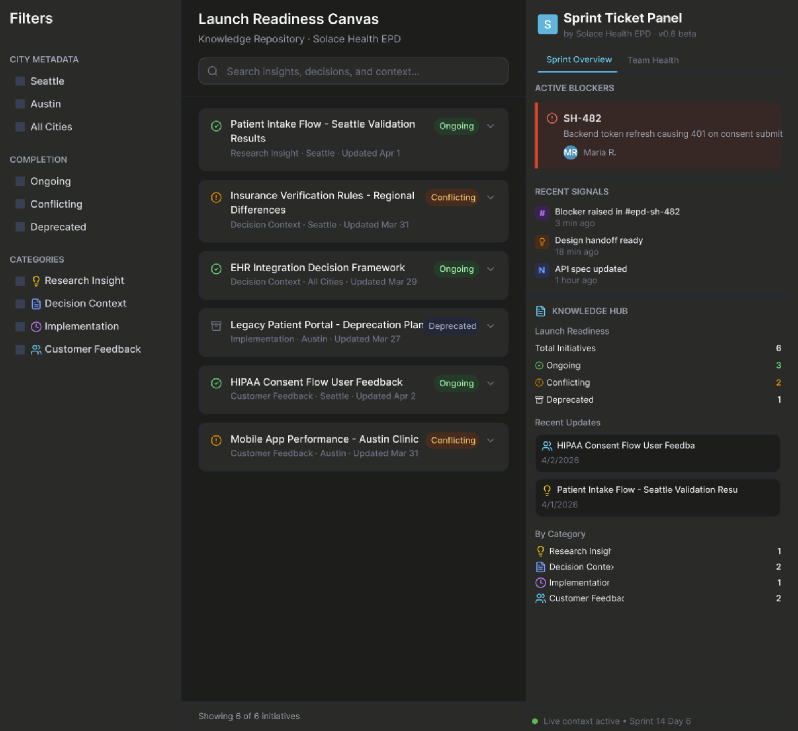
2. The Framework — Launch Readiness Canvas + Decision Context Log. Every section has a named owner. The Canvas captures decisions and local adaptations during weekly calls. The Decision Context Log persists across launches — the next city inherits it. It's required reading before any new PRD.

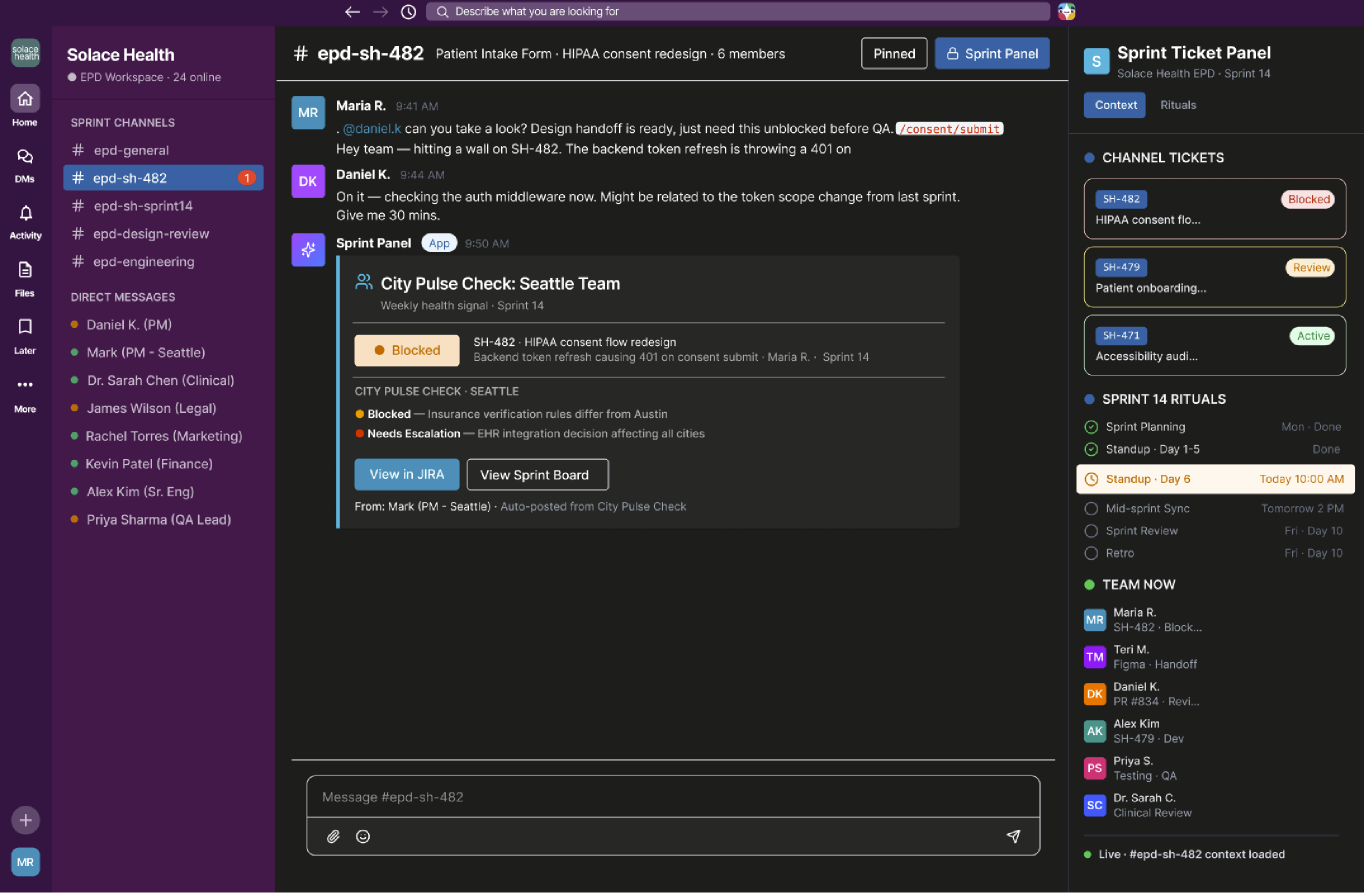
Launch Readiness Canvas and Sprint Ticket Panel
Launch Readiness Canvas with Sprint Ticket Panel

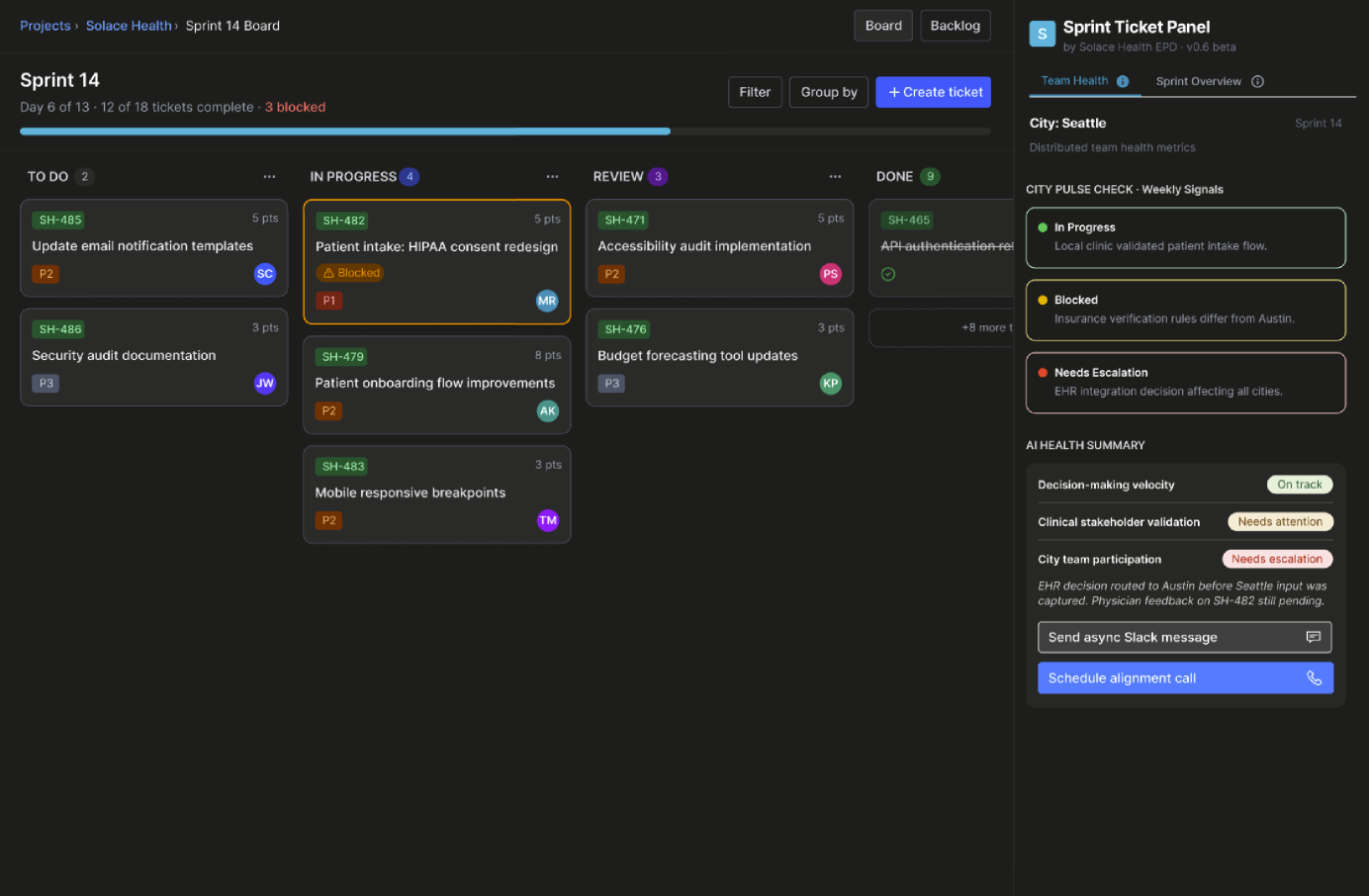
3. The Tool — Sprint Ticket Panel. A lightweight plugin that connects across Jira, Slack, and Notion. In Jira, a side panel provides sprint visibility with active blockers and team health. In Slack, it generates dedicated channels for each ticket. An AI Health Summary suggests actions without deciding for you.

Sprint Ticket Panel in Jira Sprint Ticket Panel in Slack

Teri is a designer on the Chicago expansion. Early in sprint, she catches an assumption that doesn't hold in this market. Under the old way, that flag gets buried. The sprint ships. The wrong assumption goes with it.

But here's what happens instead: Teri flags it right where she's working. Her flag surfaces in the weekly async. The right people see it. If it needs a decision, it routes to the alignment call. The decision lands in the Decision Context Log — documented, not lost. The log feeds the retro. The learnings shape the next cycle.

That's the point. Not to eliminate the hard decisions, but to catch misalignment early — before it compounds.

We conducted two rounds of usability testing with EPD professionals. The most telling finding: people didn't reject AI assistance — they rejected AI that didn't give them a reason to trust it. Auto-scheduling was universally rejected. We moved the AI Health Summary into the Sprint Ticket Panel and provided two recommendation options instead of one — giving users agency.

Usability testing findings

This project changed how I think about what designers can — and should — design. Working at the systems level meant designing rituals, decision flows, and knowledge structures instead of screens.

The core insight: psychological safety isn't just a value to aspire to — it's designable. The Pre-Kickoff Alignment Call puts the local PM first so Austin listens before it leads. The City Pulse Check makes flags visible without requiring someone to interrupt a meeting. The Decision Context Log means a designer can see what happened to her flag without asking. These are psychological safety mechanisms, not just principles.

Team culture isn't a soft problem separate from the "real" design work. It is the design work.

03 — Case Study

COROS Menstrual Cycle Redesign

What if a fitness tracker actually understood your cycle and used it to make you a better athlete?

RoleService Designer
TypeSolo Project
DurationOne Term
ToolsFigma, Miro

I'm a COROS user and a believer in women's health. When I started this project, COROS didn't have menstrual cycle tracking at all. I wanted to explore what it would look like if a fitness tracker actually connected cycle data to training, instead of treating it as a separate calendar.

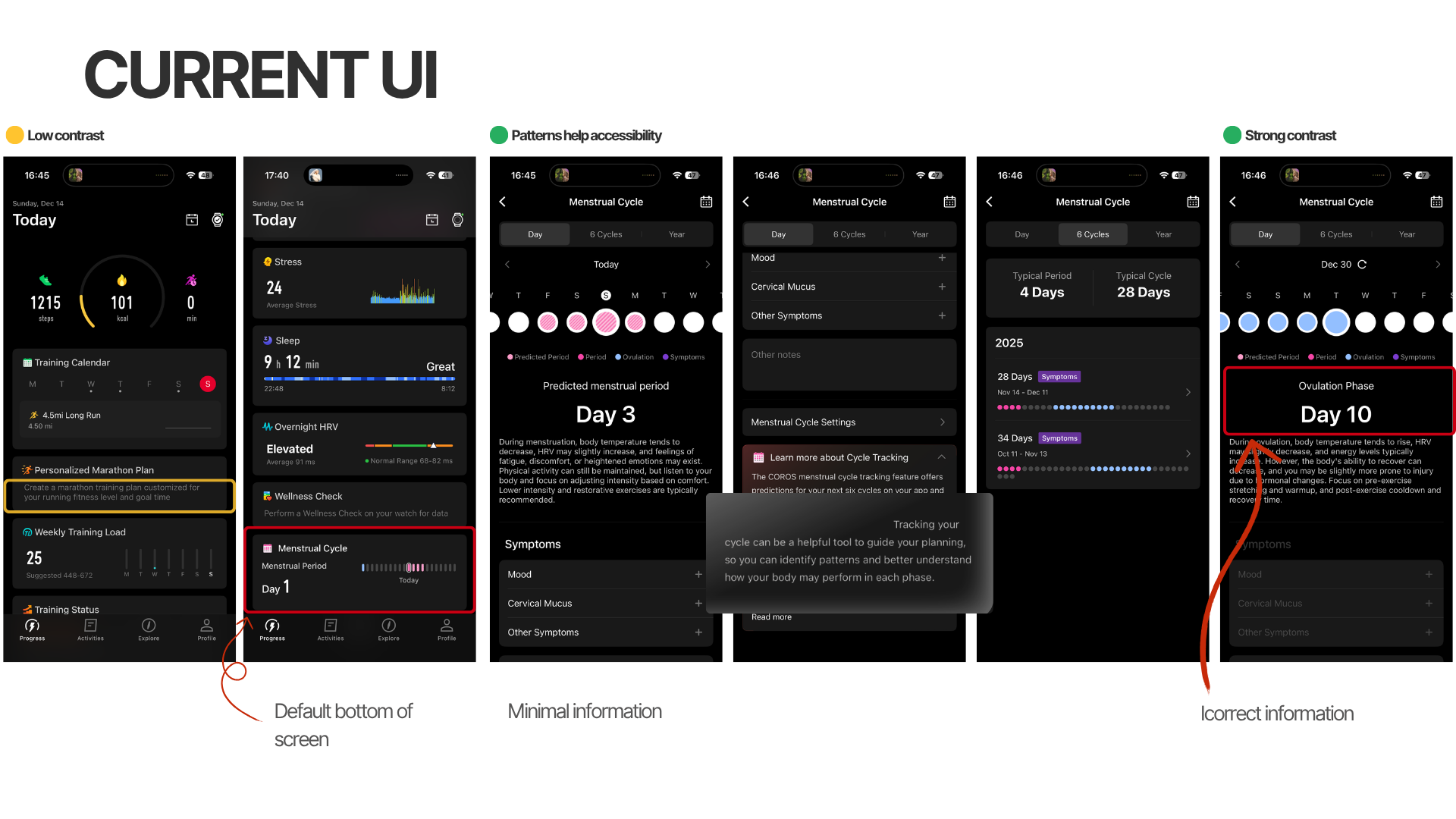
Midway through, COROS launched their version. It confirmed the gap: a basic period calendar, inaccurate ovulation predictions, and nothing tying the data back to how you train.

Current COROS cycle tracking screens

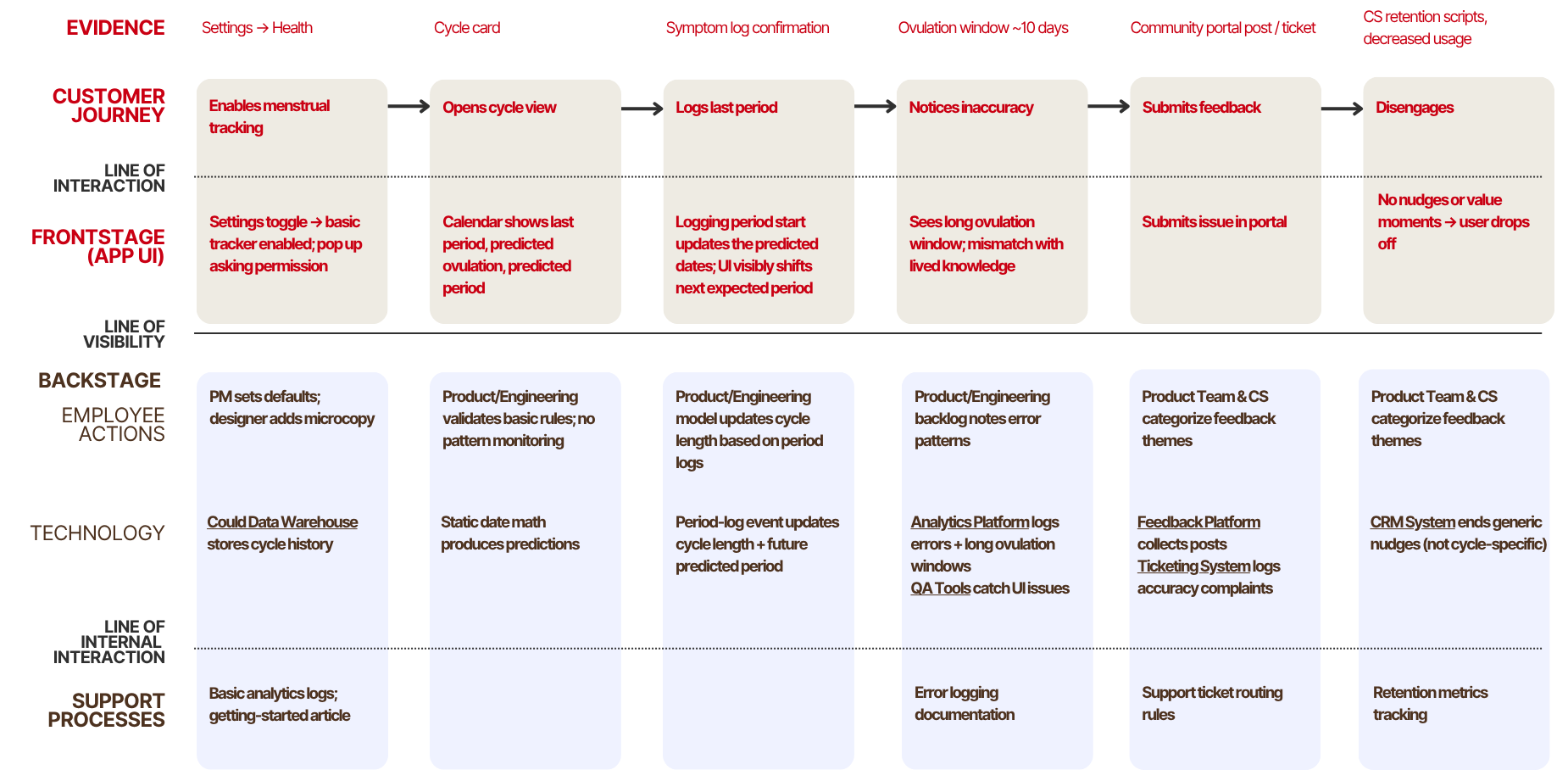
I mapped the current service from frontstage to backstage to understand where the experience breaks down and why. The biggest finding: there are no feedback loops. Data goes in, but nothing useful comes back to the user.

Current service blueprint

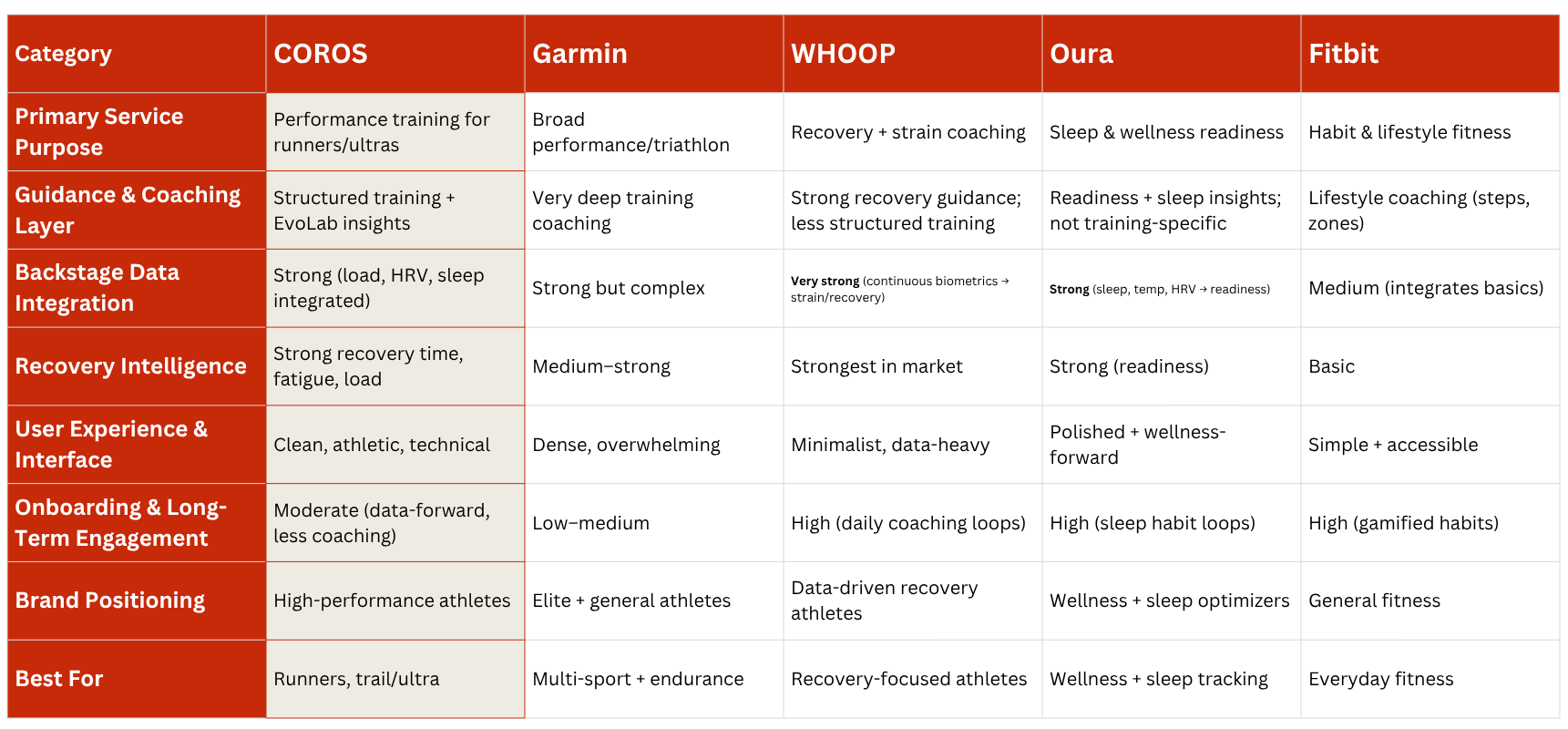
I compared five players: COROS, Garmin, WHOOP, Oura, and Fitbit. COROS is best-in-class for training load and recovery intelligence, but competitors are ahead at turning physiological data into daily coaching. The opportunity is right there.

Competitive analysis matrix

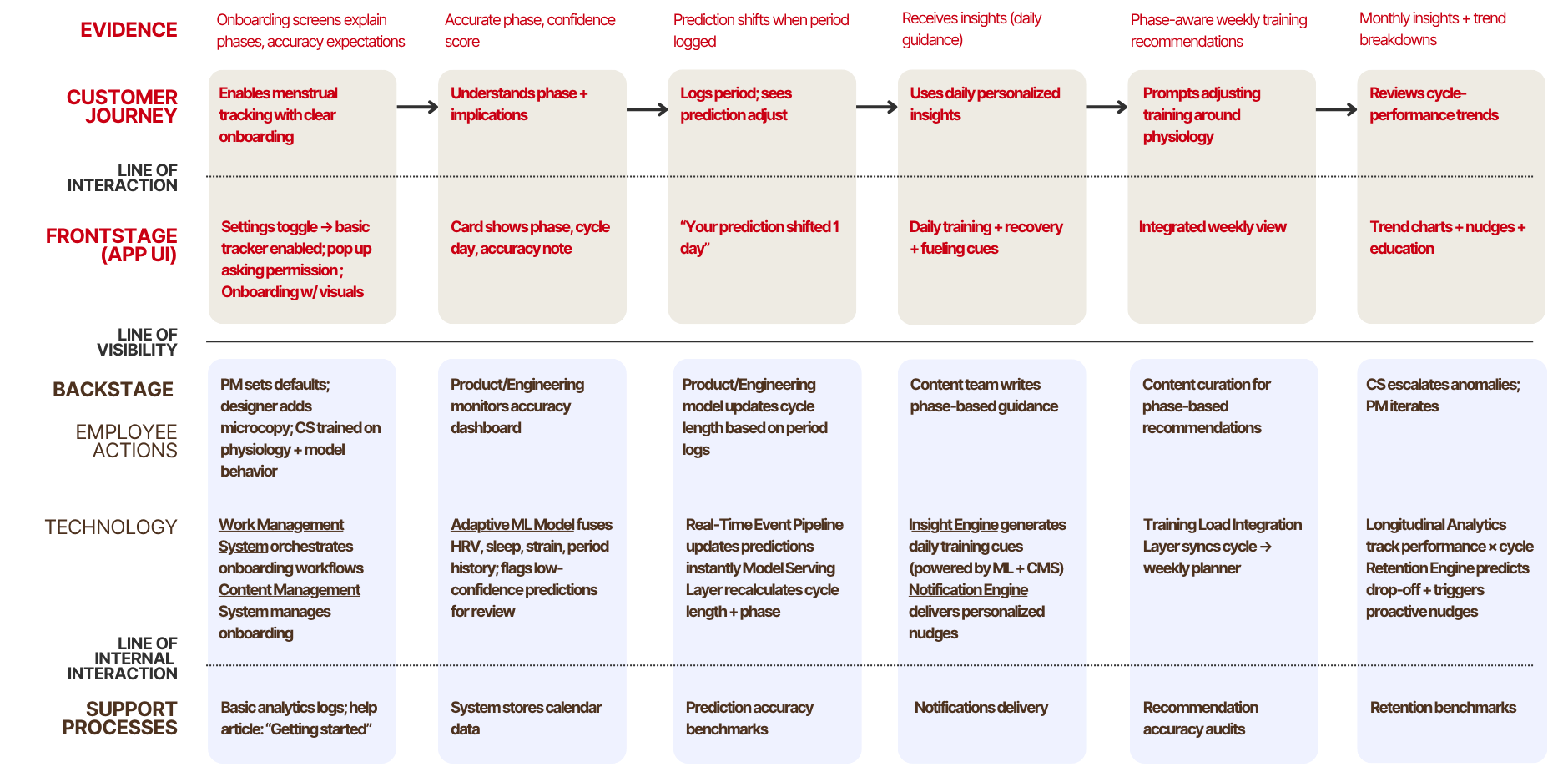
I redesigned the full service so that every touchpoint connects cycle data to training guidance. The backstage systems now learn from user behavior, feed useful insights back to the athlete, and adapt predictions over time.

Ideal service blueprint

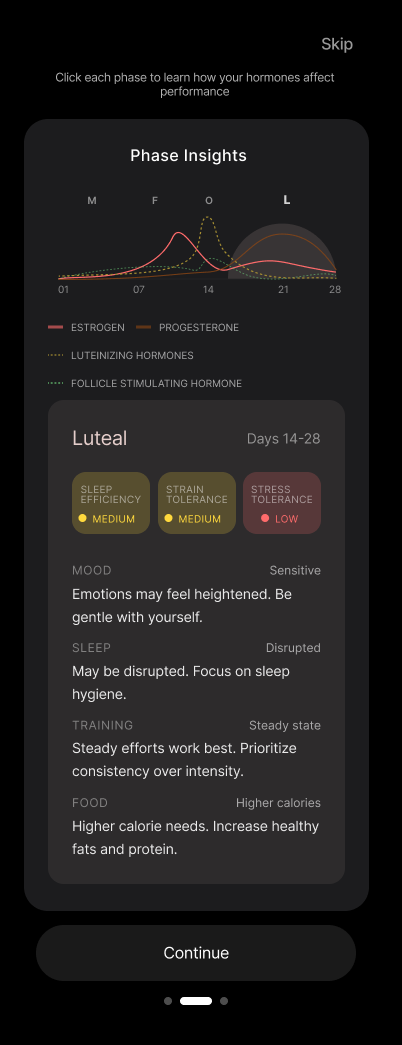
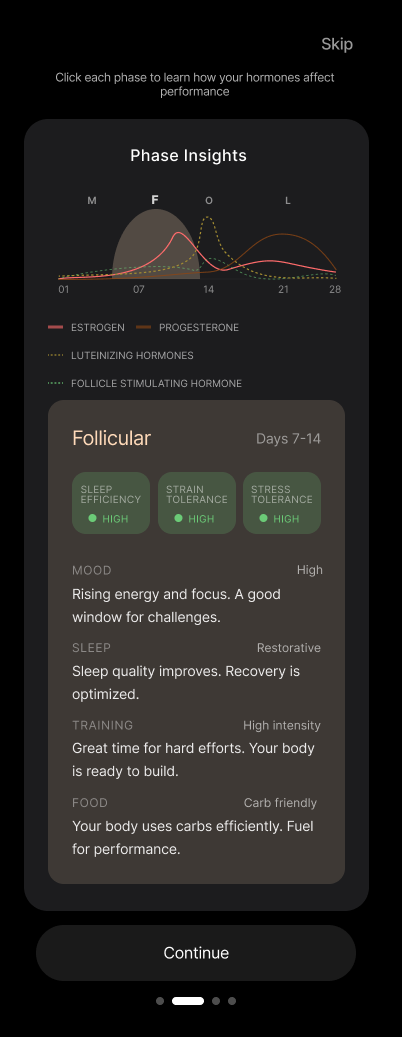
This is where trust gets built or broken. Most cycle trackers drop you into a calendar with no context. I designed an onboarding that educates first: walking users through each cycle phase with hormone curves, explaining what the data means for training, sleep, and recovery, and setting realistic expectations about prediction accuracy.

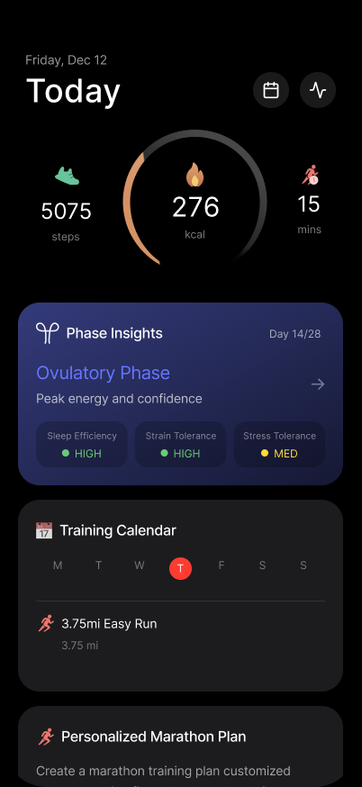
Phase Insights moves from buried at the bottom to a prominent card in the Today view, showing current phase, cycle day, and tolerance indicators for sleep, strain, and stress.

Redesigned Today screen

I started this project because I care about women's health and believe athletes deserve tools that understand their physiology. When COROS launched their version mid-project, I got to compare my research-driven approach against what a real product team shipped. That was humbling and validating at the same time.

The biggest thing I took away: mapping the full service forced me to think beyond the screen. The data pipelines, the CS workflows, the PM tradeoffs that shape what a user actually sees. I think about every design problem differently now because of this project.

04 — Case Study

Airbnb Group Booking

Group trips shouldn't fall apart before they start. We redesigned how Airbnb handles the hardest part — the money.

RoleProduct Designer
TeamEmma Moystner, Kate Foote
Duration4 Weeks
TypeConcept Redesign

Airbnb's lack of streamlined group booking puts the entire financial and logistical burden on one person, making trip planning and payments harder for everyone involved. We redesigned the group booking experience from research through high-fidelity prototype, introducing shared trip planning, flexible cost-splitting, and a centralized group hub that gives every traveler visibility and agency — not just the person holding the credit card.

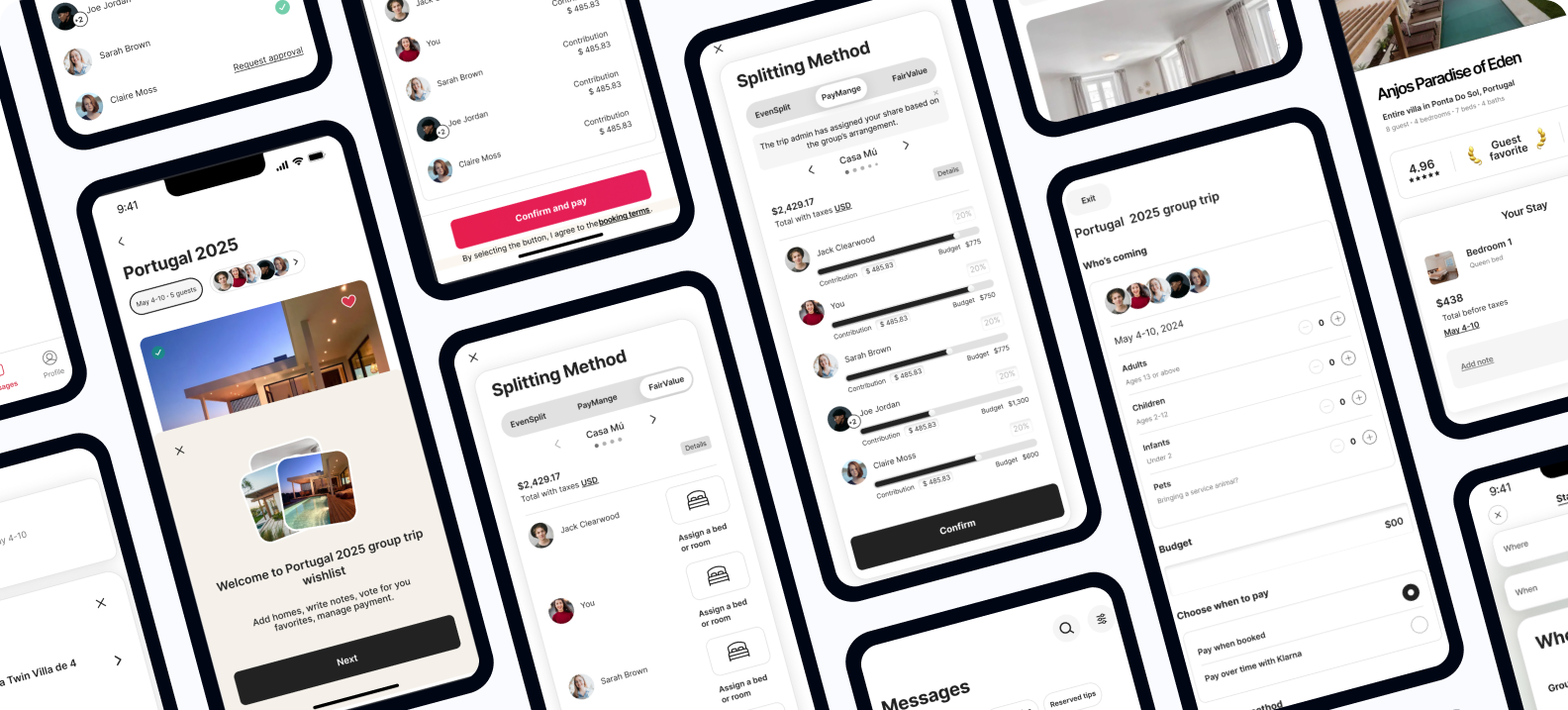
Airbnb group booking screens overview

We designed and distributed a structured survey to gather insights on how people currently navigate group bookings — not just the functional pain points, but the social and emotional friction.

82% of respondents wanted to split costs "fairly" — but "fairly" meant different things to different groups. Some wanted even splits. Others wanted to pay proportionally based on room size or arrival dates. The current system supports none of this.

63% wanted payment reminders — not because they're forgetful, but because asking friends for money is uncomfortable. People wanted the platform to handle the follow-up so they didn't have to.

71% wanted to share the planning workload — the organizer role is exhausting. Respondents wanted tools that distributed this work across the group.

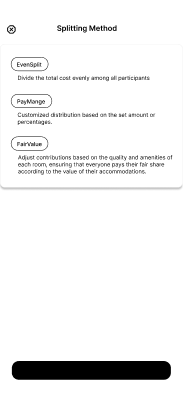
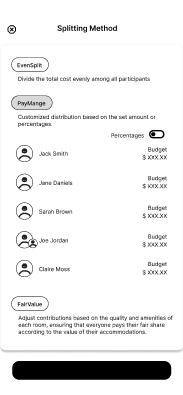
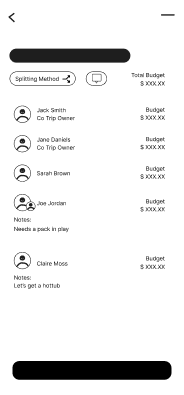
Splitting Method. We designed three cost-splitting modes — EvenSplit, FairValue, and PayManage — so groups can choose the model that matches their dynamic. An even split for close friends going halves. FairValue for proportional splits based on room or group size. PayManage for custom contribution amounts.

Splitting method selection PayManage screen Wishlist admin budget view

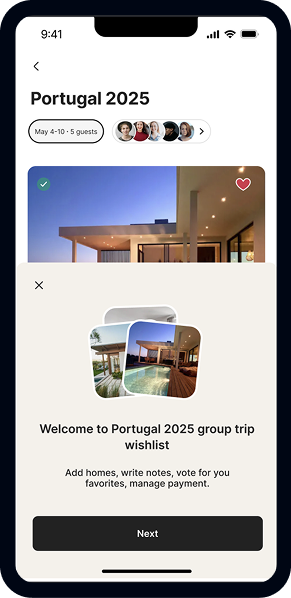
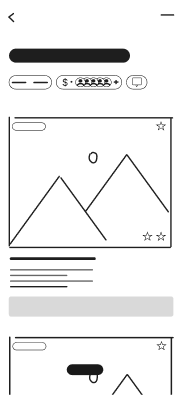
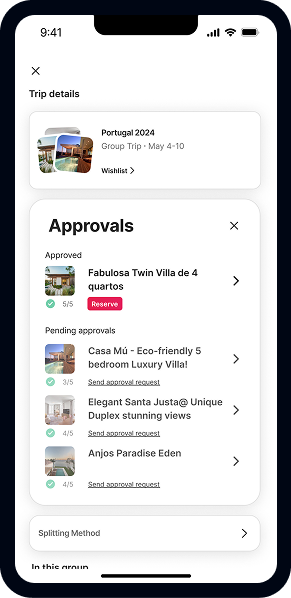
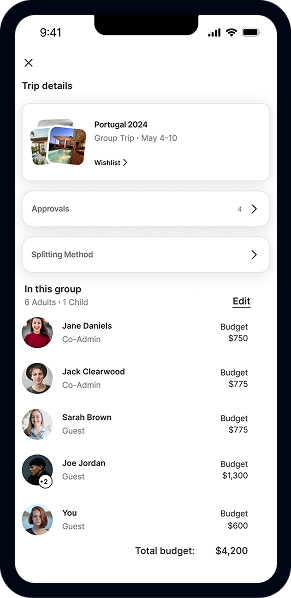
Group Trip Hub. A centralized space where the group can save listings to a shared wishlist, vote on favorites, and track the trip from planning through booking. Approvals are required to book — no one person can commit the group without consensus.

Wishlist onboarding Wishlist admin view Approvals screen Trip details

In-App Messaging. Rather than forcing coordination into iMessage or WhatsApp, we built group messaging directly into the trip flow with notification categories scoped to the trip.

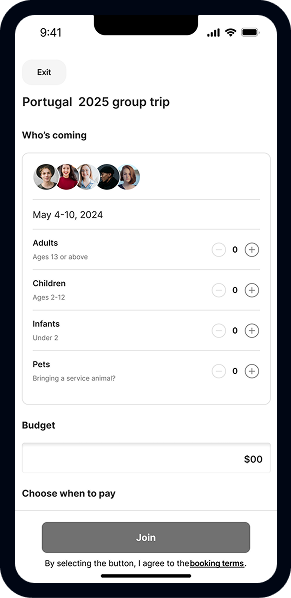
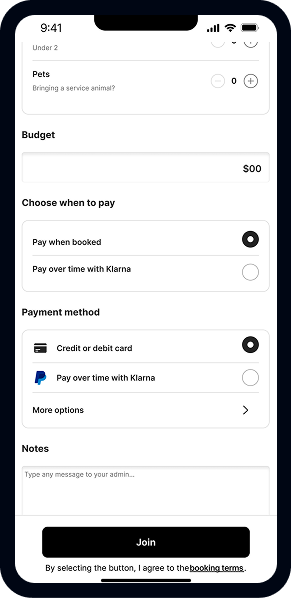
Messages overview Message thread Group join Payment join

Seamless Group Onboarding. Integrating the group feature into the wishlist flow made it intuitive for users to invite others. Users naturally understood how to start a group trip.

Clarity Drives Confidence. EvenSplit and FairValue were well-received for their simplicity. PayManage caused hesitation — users weren't sure who could see what, pointing to a need for clearer affordances around privacy and transparency.

Feedback & Visibility Matter. Users missed key elements like the comments section and expected notifications for group actions. When someone joins, approves, or pays — the group should know.

05 — Case Study

WorkTrip

I saw a broken process at my own company — paper forms, lost requests, frustrated employees — and designed the fix.

RoleProduct Designer
CompanyBarge Design Solutions
TypeSelf-Initiated / Internal Tool
StatusSolo Project

As a Project Administrator at Barge Design Solutions (an architecture and engineering firm), I had a front-row seat to how broken the company's travel process was. Trip requests were paper-based. Mileage tracking was manual and inconsistent. Employees had no visibility into whether their request was submitted, in review, or booked. Admins drowned in email chains and paper reports.

I identified the problem, pitched the solution, and designed WorkTrip — an internal app that streamlines travel requests, gives employees real-time visibility, and provides admins with cleaner, more efficient data.

I conducted interviews and observed the existing workflow. Three pain points dominated:

Unclear Booking Status. Employees struggled to track the status of travel requests due to fragmented communication and no centralized view. People submitted requests and then waited in the dark.

Inconsistent Mileage Tracking. Mileage reporting was manual, prone to errors, and led to delays and distrust in reimbursements. Employees wanted a seamless, built-in way to track mileage on the go rather than reconstructing trips after the fact.

Manual Admin Processes. Admins relied on paper-based reports and email chains. Without centralized digital tracking, pulling reports or verifying bookings was tedious and error-prone.

Version 1 focused on getting the core workflow right: a home page with quick access to key actions, easy access to company car information, and a summary page to review submitted data. This version validated the basic flow — employees could submit and track requests digitally for the first time.

Version 2 incorporated feedback and added progress tracking (a progress line showing where users are in the submission process), a redesigned home page as a centralized info hub, and a vehicle inspection checklist built directly into the app flow — a safety compliance initiative integrated without adding friction.

Submission Without Struggle. All testers successfully submitted a report without needing help. The digital process was immediately faster and less error-prone than paper.

Status Tracker = Instant Reassurance. The status tracker stood out as the favorite feature — users felt more in control knowing exactly where their request was in the process. The anxiety of "did my request go through?" disappeared.

WorkTrip stayed as a prototype — leadership was excited about it, but internal politics made implementation difficult. That tension taught me something important: solving the design problem is only half the work. Navigating organizational dynamics to get solutions adopted is its own design challenge.

This project also shows something I value: I don't wait for a brief. I identified a broken process in my own workplace and designed the fix. That instinct — seeing systems that could work better and doing something about it — is what drew me to interaction design.

06 — Case Study

Patreon Discovery

Patreon knows who you support. It should also know who you'd love to discover.

RoleProduct Designer
ContextMemorisely Bootcamp
TypeConcept Redesign

Patreon's discovery experience relies primarily on a basic search input field — useful if you already know who you're looking for, but limiting for users who want to explore. The current system assumes intent. But discovery is rarely intentional; it happens while browsing, through recommendations, through the platforms you already use.

We redesigned Patreon's discovery experience to surface relevant creators through personalized, cross-platform recommendations — and introduced Sage, an AI-powered guide that helps users find creators they didn't know they were looking for.

Discovery is Often Algorithm-Led. Users don't go to Patreon to "find someone new." They stumble across creators through other platforms. The opportunity: what if Patreon could create that discovery moment itself?

Search Limitations Block Discovery. The existing search only works if you have a specific name or keyword. For users who want to browse by mood, genre, or vibe, there's nothing.

Cross-Platform Journeys are Common. Users discover a creator on YouTube, follow them on Instagram, and eventually find their Patreon. The platforms users already live on hold the signal for what they'd want to discover next.

Redesigned Homepage. The homepage becomes a discovery surface rather than a dashboard. Shorts-style content previews give users a taste before they commit — borrowing the scroll-and-sample pattern from platforms where discovery already works.

Account Linking. Users can connect Spotify, Instagram, and other platform accounts. Their existing preferences inform recommendations — so Patreon's suggestions feel like they already know you, because in a sense, they do.

Sage — AI Discovery Guide. A conversational AI that helps users articulate what they're looking for when they can't put it into words. Instead of browsing categories or typing keywords, users describe a mood, interest, or type of content, and Sage surfaces relevant creators. It uses connected account data to curate recommendations that feel personal rather than algorithmic.

Sage Makes a Strong First Impression. Users quickly grasped the purpose of Sage, describing it as "friendly" and "engaging" within moments of use — indicating strong onboarding and personality alignment.

Connection Is Powerful — But Needs Clarity. Participants appreciated account linking but expressed concerns over data control, signaling a need for more transparent permissions and settings.

Transparency Builds Trust. A majority of testers wanted clearer explanations for why creators were recommended. The recommendation isn't enough — users want to know why.