Overview
When the airline knows what you need before you do, who is really in control? Designing the interaction layer for a future where AI-driven anticipation has replaced most active passenger decision-making.
A system that acts on your behalf can just as easily feel like surveillance.
Airlines are investing heavily in anticipatory technology (AI rebooking engines, biometric identity, ambient spatial interfaces), but they’re designing for efficiency, not trust. Delta’s AI concierge can already rebook you during disruptions. Biometric gates are rolling out globally. Parallel Reality displays at Detroit show personalized information to 100 passengers on a single screen.
The technology is arriving. The question is less about what it can do; it’s what it should feel like. Imagine a system that acts on your behalf and leaves you feeling more in control, not less: it books the trip, clears the morning, routes around the delay you hadn’t noticed yet, and not once do you feel watched.
The difference between served and surveilled was never capability. It’s legibility, whether you can always see what it’s doing and why. That’s the future worth designing.
The barrier to anticipatory systems isn’t technology. It’s trust.
I ran a STEEPX analysis mapping emerging signals across social, technological, economic, environmental, political and experiential dimensions. A Causal Layered Analysis then dug beneath the surface-level technology trends to find the structural beliefs underneath them.
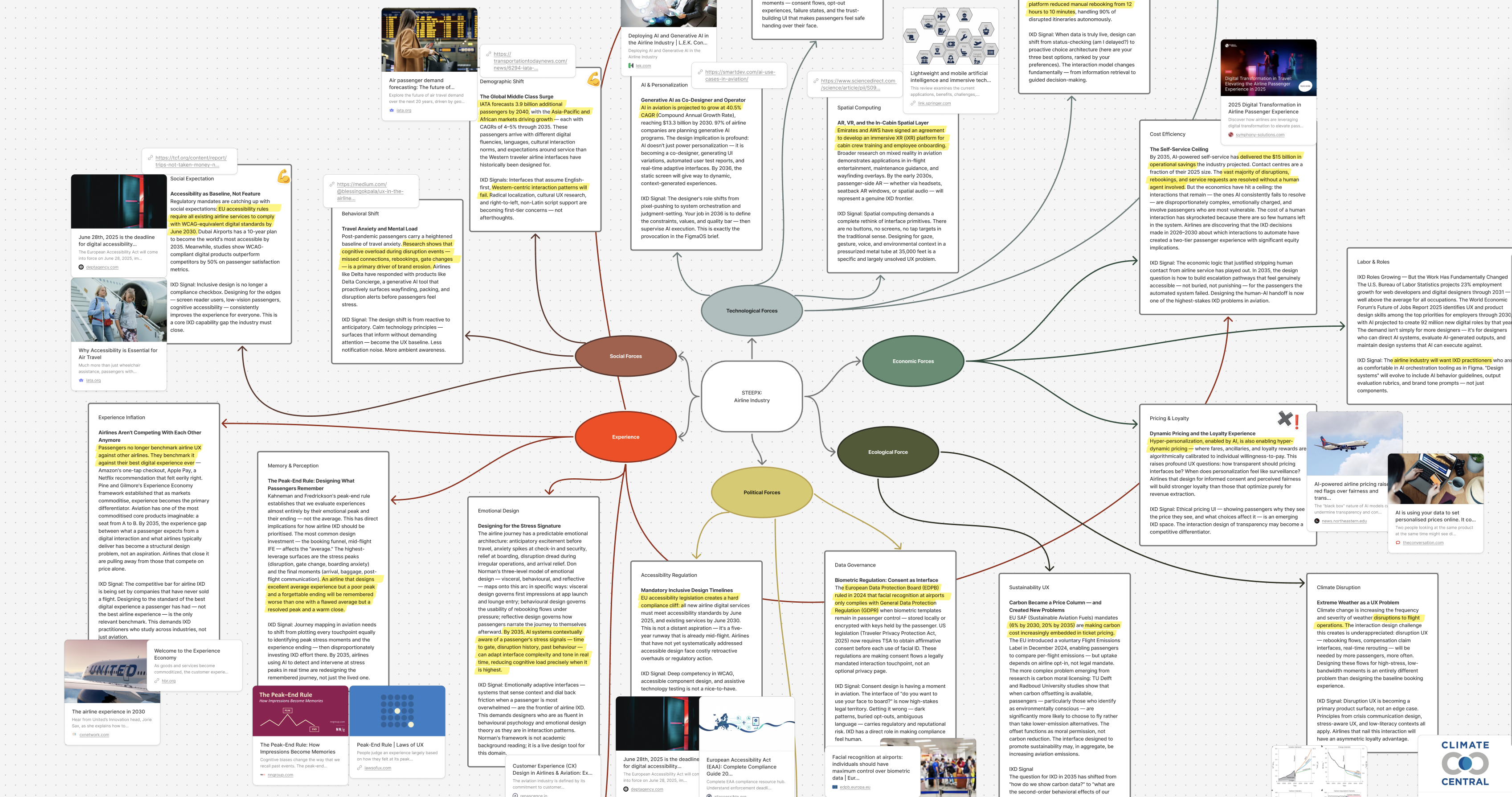
STEEPX: the forces shaping airline interaction by 2036
Socially, post-pandemic travel anxiety is baseline. Technologically, the capability exists but adoption moves at the speed of trust, not innovation. Economically, dynamic pricing makes passengers feel surveilled, not served. Politically, biometric consent is now legally mandated interaction design. Experientially, passengers benchmark against Amazon and Apple Pay, not other airlines, and that gap is structural.
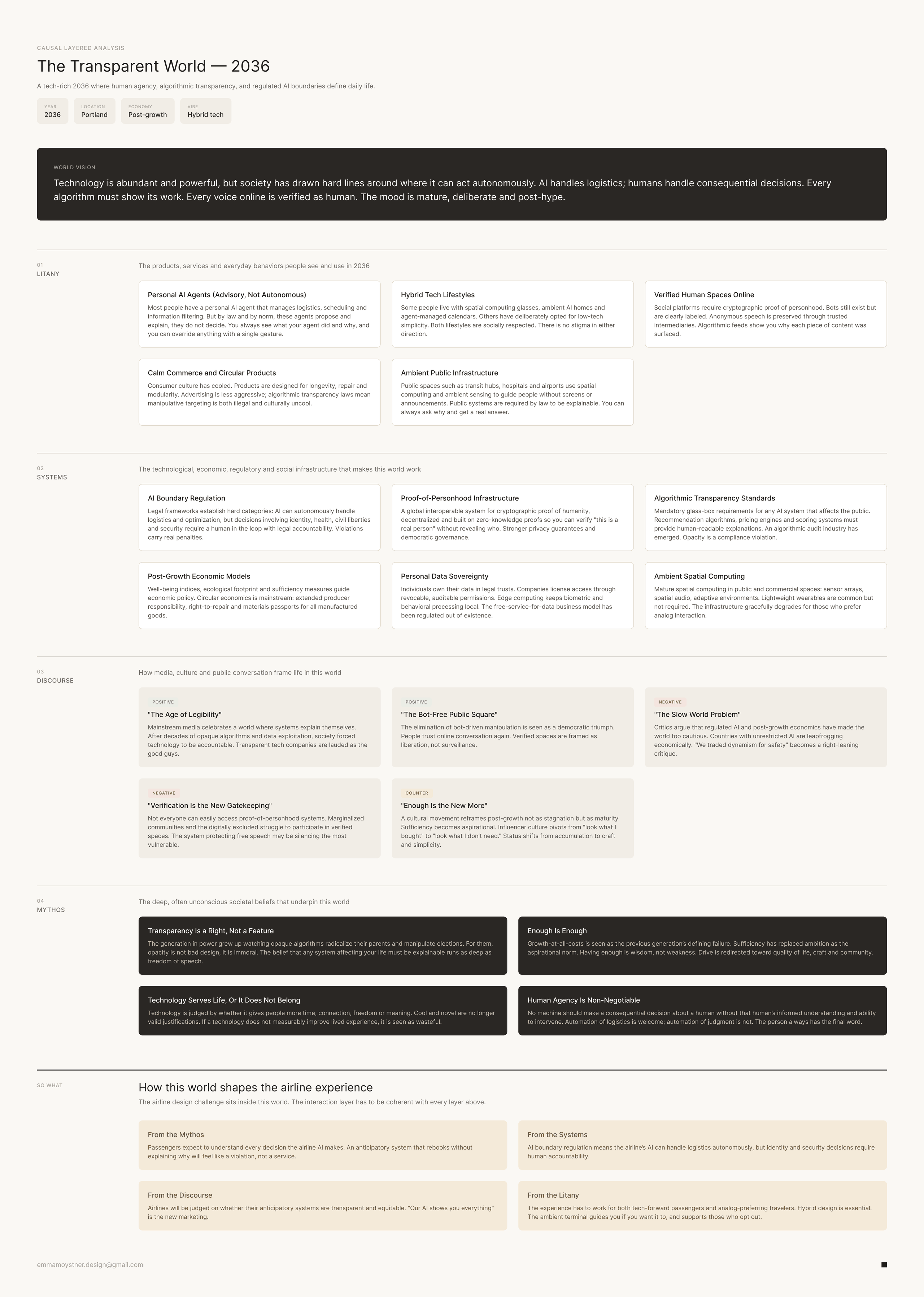
CLA Map — The Transparent World 2036
Click any to see it closer
Great tech usually disappears. A great host doesn’t.
A good host is present but not intrusive, explains without lecturing, and anticipates without presuming. Invisibility removes the one thing a passenger needs most when a system acts for them: the ability to see it acting.
There is no set of final screens. The film is the deliverable.
A narrated speculative film follows Noah Almeida, flying Portland to Chicago to D.C. for a grant review, when a storm cancels his connection. In 2036 the airline reroutes him through JFK and books an air taxi into D.C., showing what it’s doing and leaving him the choice to override it.
Narrated speculative film · 2 min 9 sec
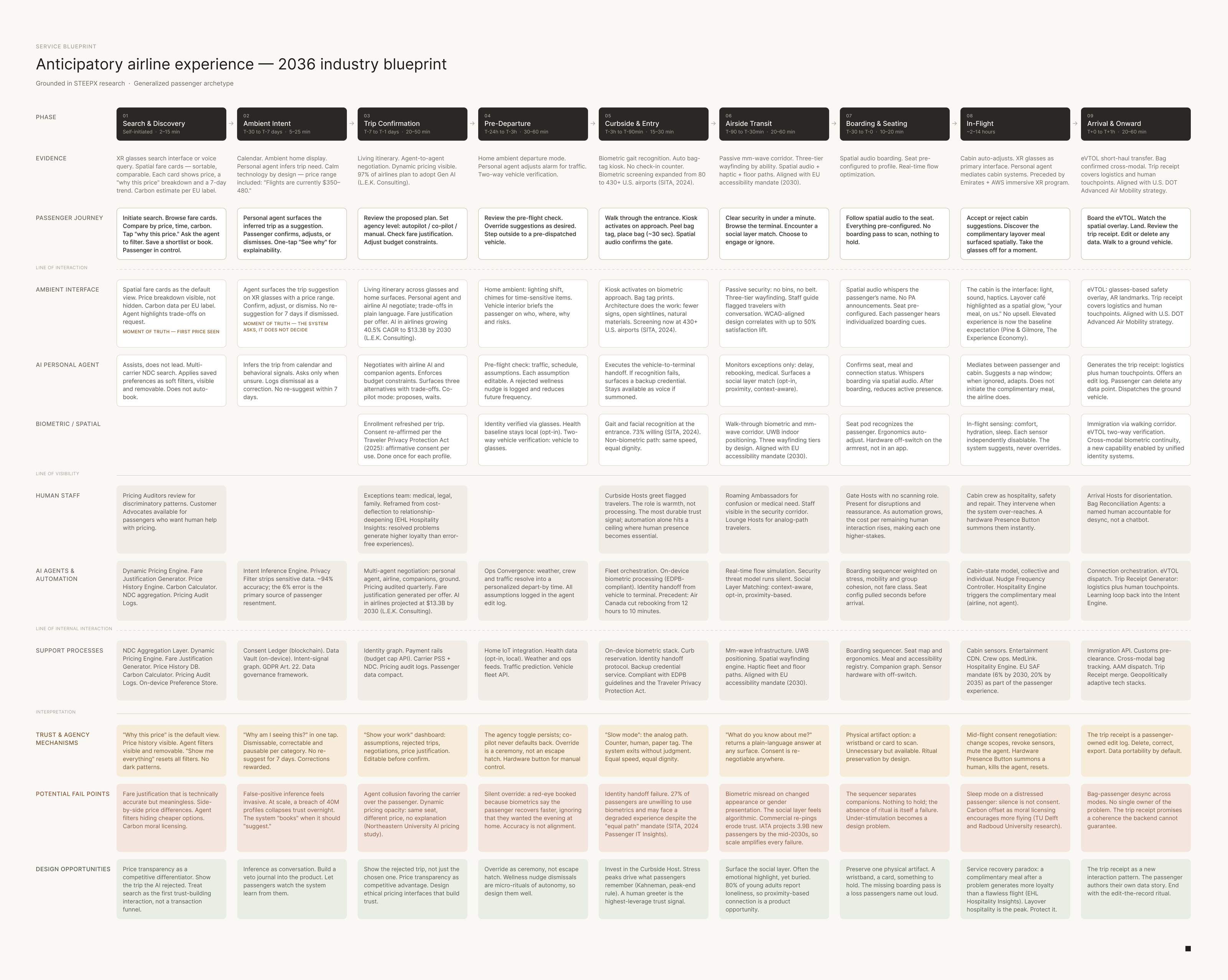
Service blueprint · the backstage that would have to run all three
Click to see it closer
Every scene in the film was built to test one mechanism. Three of them carry the whole thesis, and each one is a different answer to the same question: how does a system that acts for you stay legible while it does it?
The system proposes, the passenger decides, and it remembers the preference. Not a binary on/off for AI but a spectrum of control the passenger can move along, which matters because the right amount of automation is different on a commute than it is on a first international flight.
Every AI decision shows its reasoning in plain language. When a flight cancels, the system offers three reroute options with their tradeoffs stated: fastest arrival, best seat, most flexibility. It shows its work, which is what turns a decision made for you into a decision you agreed to.
The system doesn’t just recover from disruption, it finds new possibilities inside it. Trust is earned not only by explaining and offering choices but by being genuinely useful when things break. The air taxi is the test case: an option the passenger would never have found.
Made by machine, directed by me.
This one runs the other way. The film was generated — the shots, the environments, the motion. I chose to work that way on purpose: futures casting needs an artefact from inside the future, and generation is how a solo designer gets one. What the tools never had was the argument.
- What the machine did
- Artlist Studio, running Nano Banana 2, generated the hero stills and the image-to-video. ChatGPT and Claude were thinking partners during the STEEPX scan. The rendering, in other words — the surface of the thing.
- What I did
- The brief, the research, the position the film exists to make, the script, the shot list, the edit in CapCut, the sequencing, and every frame of the design language in Figma. Machine-led on the pixels. Human-led on the point.
Scale · Human–Machine Collaboration, Dubai Future Foundation
What this one changed about how I work
The hardest design decision was resisting the urge to make the system invisible. The instinct in anticipatory design is to remove friction entirely, to make things just work. But the CLA’s deepest layer revealed that human agency is non-negotiable. A system that acts perfectly but invisibly isn’t a good host. It’s a benevolent captor.
The project’s core argument: technology that anticipates your needs isn’t enough. It has to show its work, give you choices, and be genuinely resourceful when things break. That’s not invisible technology. That’s a good host.
Next project Solace Health →